
Hello AFM community!
My name is Rachel Yager, I am a second year Master of Public Health student at the UofA, and I am very excited to be completing my practicum with AFM over the next few months. I wanted to take a moment to introduce myself, as I will be sharing monthly progress updates on my practicum experience and key learnings.
I bring a background of nutrition and food science, with particular interest in the intersection of climate change, health, and nutrition. I currently work with e4c’s school nutrition program, helping facilitate morning meals across schools in Edmonton. Therefore, when the Coalition for Healthy School Food connected me with Alberta Food Matters, I was immediately drawn to this opportunity, it truly felt like everything had aligned.
Part of my practicum experience so far has been attending AFM’s Community of Practice meetings (among many others), which has provided me with a better understanding of how this work is taking shape:
- In June 2024, the Canadian government released the National School Food Policy - a major step towards ensuring all students in Canada have access to nutritious food. This policy outlines a long-term vision and commitment to improving universal access to healthy meals for children while reducing food insecurity. This policy also helps support and guide the implementation of Canada’s National School Food Program.
- Most recently, efforts such as Bill C-15 received Royal Assent. While the bill does not directly allocate new funding, it reinforces the federal government’s commitment, by embedding school food programs within a broader policy and legislative framework. Together, these developments signal growing momentum and long-term support for school food initiatives across Canada.
So, why does this matter?
Providing nutritious food in schools goes beyond physical health. Through my work with e4c, I have also been able to see these impacts firsthand.
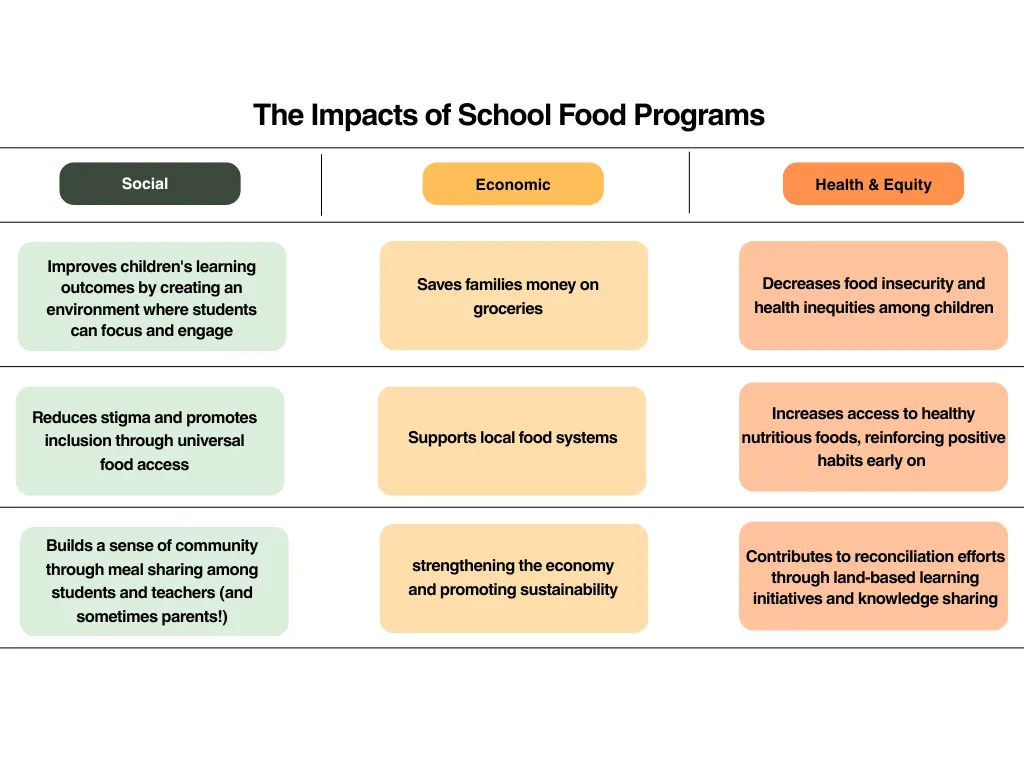
Text version of “The Impacts of School Food Programs”
Social
- Improves children’s learning outcomes by creating an environment where students can focus and engage
- Reduces stigma and promotes inclusion through universal food access
- Builds a sense of community through meal sharing among students and teachers (and sometimes parents!)
Economic
- Saves families money on groceries
- Supports local food systems
- Strengthening the economy and promoting sustainability
Health & Equity
- Decreases food insecurity and health inequities among children
- Increases access to healthy nutritious foods, reinforcing positive habits early on
- Contributes to reconciliation efforts through land-based learning initiatives and knowledge sharing
Now, where does my practicum experience fit into all of this?
In March 2025, The Government of Alberta ratified the Canada-Alberta National School Food Program, meaning an additional $43 million of federal funding over the next three years in addition to existing provincial support. This funding can be used for a range of purposes including food provision, staffing, developing infrastructure, administration, and research.
However, for school food programs to be effective and sustainable, they must be evidence-based and support each community’s unique needs - particularly in rural areas, where infrastructure and access varies significantly among communities.
This is where my work comes in! As part of a broader research project for the Government of Alberta led by Farm to Cafeteria Canada and the Coalition for Healthy School Food, my role focuses on supporting early-stage efforts to understand the current school food landscape. This includes exploring entities that currently support, or have the potential to support, school food programs across rural communities in northern Alberta, with the goal to identify gaps and opportunities to inform next steps. We are still in the early stages, and I am looking forward to how this work evolves.
Thank you for reading, and stay tuned for next month’s update!
For additional information, or questions about the project and how you may be able to help, please feel free to reach out to Amberley Ruetz (amberley.ruetz@usask.ca) or Jesse Veenstra (jveenstra@farmtocafeteriacanada.ca)