
Hello AFM Community!
It is hard to believe that I have reached the end of my practicum, and this will be my final post sharing my practicum journey.
First, I want to say thank you to all the school authorities that took the time to connect with the research team at Farm to Cafeteria Canada, complete the survey, and share their school food programs. Every conversation, survey response, and example of best practice provided valuable insight into the current school food environment across northern Alberta.
As many education staff are now enjoying a well-deserved summer break, we have had the opportunity to pause and reflect on both the qualitative insights gathered through conversations and the quantitative findings from our survey. The timing also feels fitting for me personally, as the end of my practicum has given me the chance to reflect on my experience entering the field as a public health professional and the kind of work I hope to continue pursuing throughout my career.
When I started my Master’s in Public Health with a Bachelor’s in Nutrition and Food Science, I knew my area of interest was food security. Since we are responsible for finding our own practicum placements, I had no idea where to begin. As I progressed through my degree, learning more about climate change and food systems broadened my perspective and further shaped the direction I wanted to take my career. This practicum became the perfect opportunity to bring those interests together. Contributing to a community-based research project that documents innovative practices and supports the future development of school food programs has been incredibly rewarding and has confirmed the direction I hope my work will continue to take.
Working with e4c before beginning this project also gave me firsthand experience supporting school food programs in the Edmonton area. That experience, combined with my practicum, particularly reinforced a couple of key lessons for me:
- Program operations are highly dependent on infrastructure, resources, and community. Every school food program is unique, and what works in one community may not work in another. This project exposed me to innovative approaches to school food while helping me better understand the policies, partnerships, and food systems that support these programs across northern Alberta.
- School food programs are about much more than providing meals. They are opportunities to strengthen local food systems, support communities, improve health equity, and create lasting benefits for students and families.
I also developed a new appreciation for community-based research. Coming from a science background, I was used to thinking that data should always be complete and precise. This project reminded me that when you’re working with communities, the goal is not always perfect data. It is about listening, building relationships, documenting what people share, and using that information to better understand what is happening on the ground.
This practicum strengthened my skills in community-based research, collaboration, communication, systems thinking, and knowledge translation, while reinforcing the importance of approaching public health challenges with curiosity and an open mind. Looking back, here are some of the key skills I developed throughout this practicum and how I applied them:
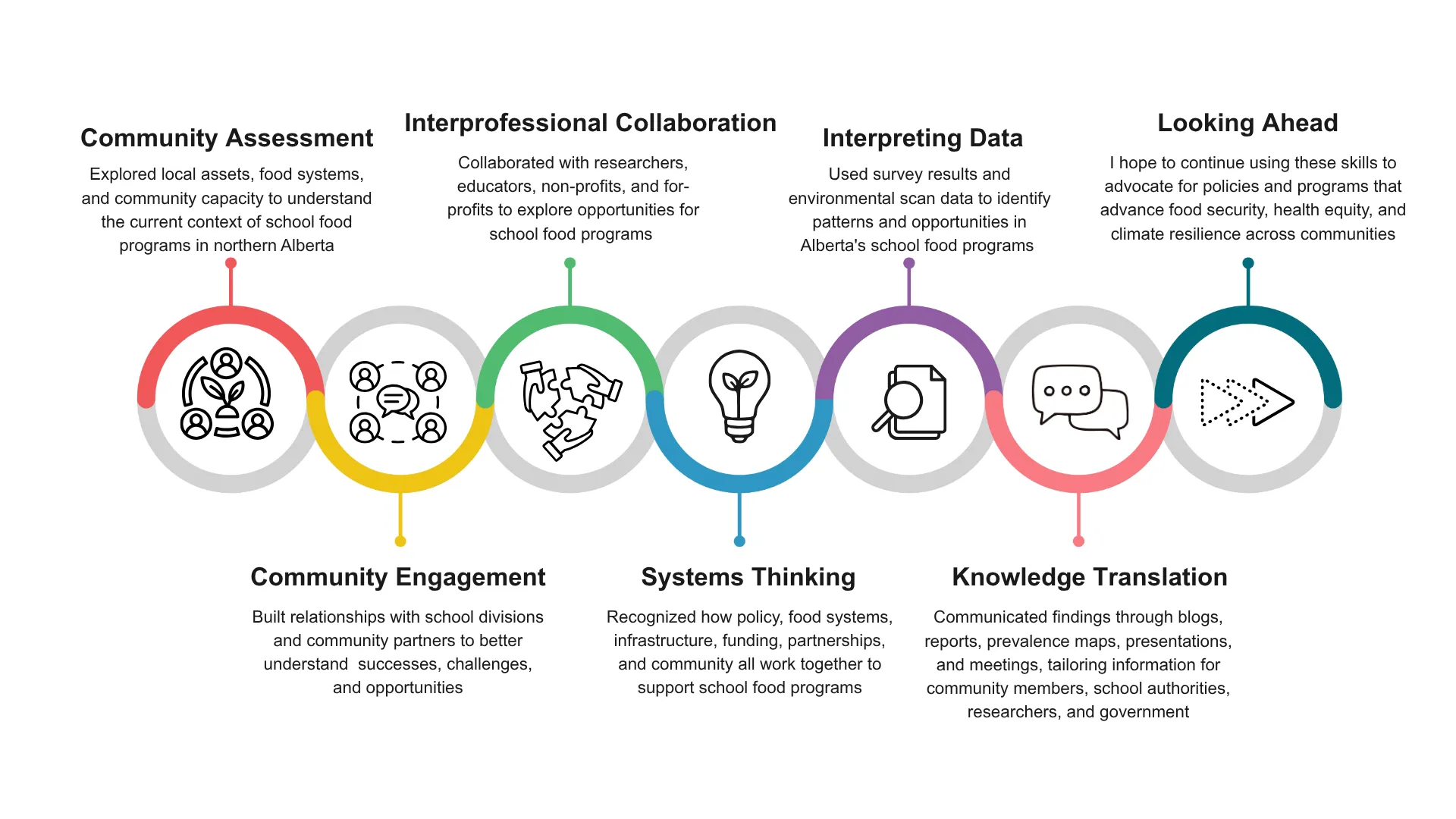
Text version of the practicum skills infographic
- Community Assessment: Explored local assets, food systems, and community capacity to understand the current context of school food programs in northern Alberta
- Community Engagement: Built relationships with school divisions and community partners to better understand successes, challenges, and opportunities
- Interprofessional Collaboration: Collaborated with researchers, educators, non-profits, and for-profits to explore opportunities for school food programs
- Systems Thinking: Recognized how policy, food systems, infrastructure, funding, partnerships, and community all work together to support school food programs
- Interpreting Data: Used survey results and environmental scan data to identify patterns and opportunities in Alberta’s school food programs
- Knowledge Translation: Communicated findings through blogs, reports, prevalence maps, presentations, and meetings, tailoring information for community members, school authorities, researchers, and government
- Looking Ahead: I hope to continue using these skills to advocate for policies and programs that advance food security, health equity, and climate resilience across communities
Finally, I want to thank the Coalition for Healthy School Foods and Alberta Food Matters for welcoming me as a practicum student and connecting me with Farm to Cafeteria Canada to work on this project. I am incredibly grateful for everything I have learned over the past few months.
Although my practicum has come to an end, I am excited to share that I will continue working on this project and remain involved with the Alberta School Food Community of Practice. I look forward to seeing how school food programs continue to grow across Alberta and am excited to continue contributing to this important work.
Hopefully I’ll see some of you at the next Community of Practice!
Rachel Yager