
Happy summer AFM community!
The third month of my practicum felt like it flew by as survey responses came in and awareness of the project continued to grow. Thank you to everyone who has responded, shared the survey, or reached out to learn more.
Over the past month, I have had opportunities to connect with individuals involved in school food programs, learn more about procurement and distribution considerations, explore land-based learning initiatives, and learn the various roles of non-profit organizations in supporting students. These conversations have expanded my understanding of the many considerations involved in supporting school food programs, from logistics and infrastructure, to partnerships and community capacity. I have also been exposed to innovative solutions, and challenges I had never considered before.
After several weeks of reviewing the current school food environment and regional food systems across northern Alberta, some themes have begun to emerge. It has been encouraging to see that across the province there are dedicated individuals, organizations, and communities working to ensure students have access to nutritious, culturally relevant food.
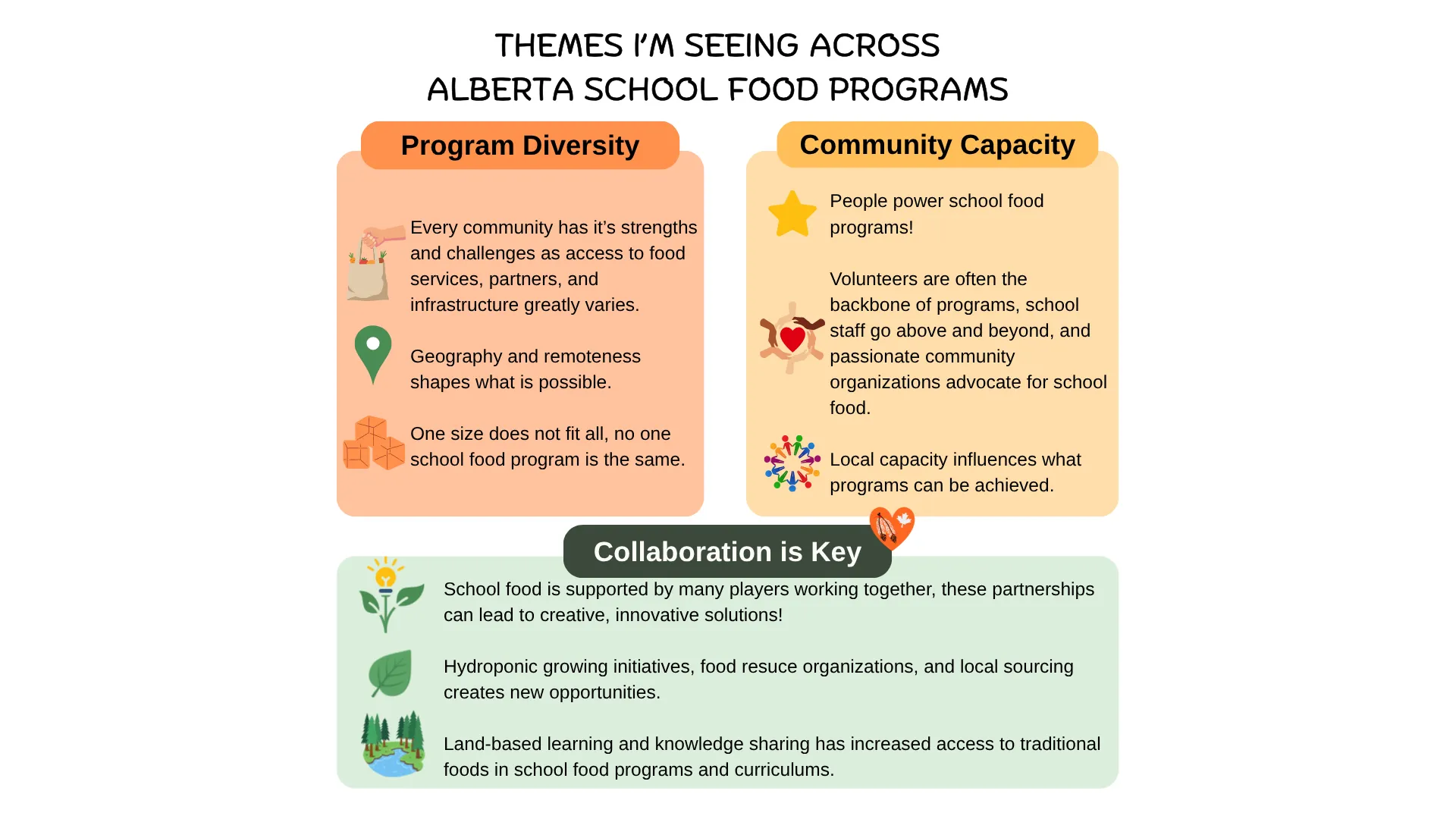
Text version of “Themes I’m seeing across Alberta school food programs”
Program Diversity
- Every community has its strengths and challenges as access to food services, partners, and infrastructure greatly varies.
- Geography and remoteness shapes what is possible.
- One size does not fit all, no one school food program is the same.
Community Capacity
- People power school food programs!
- Volunteers are often the backbone of programs, school staff go above and beyond, and passionate community organizations advocate for school food.
- Local capacity influences what programs can be achieved.
Collaboration is Key
- School food is supported by many players working together, these partnerships can lead to creative, innovative solutions!
- Hydroponic growing initiatives, food rescue organizations, and local sourcing creates new opportunities.
- Land-based learning and knowledge sharing has increased access to traditional foods in school food programs and curriculums.
I entered this practicum expecting to learn more about the operations of school food programs and the challenges around accessing food, particularly in the north. While I am certainly becoming more aware of the logistics involved in delivering school food programs, I am also beginning to understand more of the broader economic and social opportunities these programs can provide.
Therefore, as additional federal funding becomes available over the coming years, I see this as an opportunity to think strategically about how resources are invested, beyond simply ensuring students are fed. This potential to strengthen local food systems and further implement innovative models will help make school food programs more sustainable in the long-term, while supporting community development.
I am looking forward to continuing exploring partnerships, opportunities, and innovations that are helping shape school food systems.
Thank you for reading, and stay tuned for next month’s update!
For additional information, questions about the project, or if you would like to connect, please feel free to reach out to Amberley Ruetz (amberley.ruetz@usask.ca) myself (yager@ualberta.ca), or Jesse Veenstra (jveenstra@farmtocafeteriacanada.ca).